
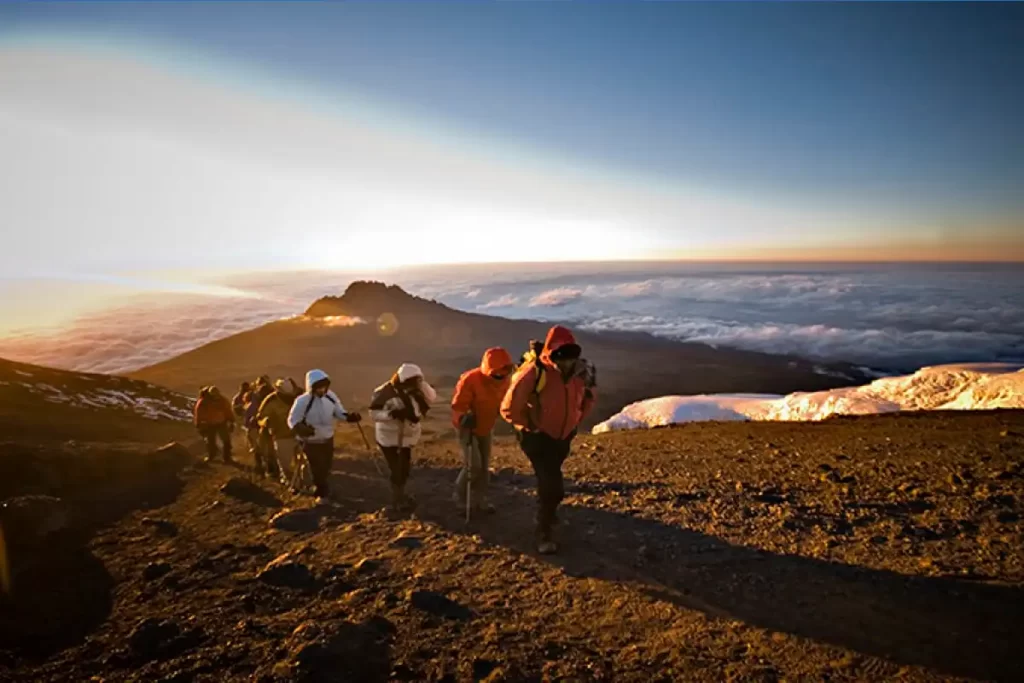
The Marangu Route is the oldest on Kilimanjaro and one of the most popular, owing to the fact
that it is the only route on the mountain with huts for hikers. Mandara and Kibo Huts each have
60 bunk beds, and Horombo Hut has 120 bunk beds. This route will take you 6 days to
complete. The Marangu route can be completed in 5 days, but climbers should allow an extra
day to acclimate at Horombo Hut.
Your first night will be spent in a hotel in Arusha or Moshi. If you have chosen to be picked
up from Kilimanjaro International Airport, you’re The Africa Safaris driver will be waiting to
greet you and take you to your Arusha or Moshi lodge to relax after your flight.
After an early breakfast (07.00) at your lodge, we depart one hour later and arrive at the
Marangu Gate around 11.00, ready for registration and the start of the trek.
As the porters load up your equipment and you meet the trekking team who will accompany
you up the mountain, your excitement grows. Starting on the south-east side of Kilimanjaro at
1900 meters and ending the day at 2720 meters, our total walking time today to Mandara Hut
– where we will spend the night – is approximately 3.5 to 4 hours (excluding breaks), covering
just over 8km. We begin the walk-in late in the morning, eat our picnic lunch around 14.00,
and then continue walking until we arrive at the hut at 17.00. Dinner will be served at 19.30
p.m. Despite the fact that it is almost entirely uphill, today's walk is a on the way up, there's a
chance to see some blue monkeys or admire the rainforest vegetation.
Our early 07.00 breakfast gets us ready for an 08.30 departure, and today's 11km walk will take
between 5.5 and 6 hours of actual walking time (excluding breaks), with a total elevation gain
of 1000 meters to the finish line in Horombo (altitude: 3720 metres).
On the way, we'll stop for a picnic lunch at 13:00 before continuing our climb and arriving at
Horombo hut around 16:30. At 18.00, dinner will be served. On today's walk, you'll notice that
the forest landscape gives way to moorland and heather as we pass by the famous Maundi
Crater. Overall, the scenery is becoming more barren, but some of Kilimanjaro's iconic plant
species can still be seen today. Keep an eye out for the intriguing giant groundsels, lobelias,
and protease. If you're fortunate enough to have a clear day, you should have the first
opportunity to see Kibo's snow-capped peak as well as the distinctive Mawenzi peak. You will
be staying in a dormitory once more.
Today, we'll climb another 1000 meters, cover about 9 kilometers, and aim to arrive at the Kibo
hut for our overnight stop around 15.00. We start early once more, with a 07.00 breakfast and
an 08.30 departure.
We choose the southern (left-hand) route where the path divides today. On this route, we stop
to replenish our water reserves at the Maua River, the last usable water supply at a height of
around 4,000 meters. Today's stage is rather steep at first, and there is less vegetation, but we
are rewarded with our first glimpse of some of Kilimanjaro's famous 'cones' today. The picnic
lunch has been rescheduled for 13.00. Overnight stays at Kibo Huts are simple and made of
stone.
Our 'Summit Day' agenda is quite different. We get up at 23.00 and have tea and biscuits
(23.30) before our midnight departure. Today, we have approximately 1175 meters to climb on
what will be our most difficult day, with approximately 13 hours of actual walking time and a
distance of 21 kilometers.
We expect to reach the summit around 07.00 a.m. We start on a rocky path and then ascend
through a series of zig-zags that get smaller and smaller.
On our way up today, we'll stop at William's Point (5131 meters), Hans Meyer Cave (5258
meters), and Gillman's Point (5719 metres). Today's emphasis is on walking slowly. When we
reach the summit, we take a moment to celebrate our successful climb, take photos, and
congratulate ourselves before beginning the descent to return to Kibo hut by 11 a.m. take a
well-deserved two-hour break and a delicious hot lunch. We set off again at 14.00 and continue
our descent until we arrive in Horombo around 17.00. At 19.00, dinner will be served.
At the 'Tipping Celebration,' we take the opportunity to thank our hardworking guides and
porters after breakfast at our now-familiar time of 07.00. We leave Horombo and begin our
descent towards Marangu Gate, stopping for a hot lunch at Mandara around midday.
Marangu Gate is reached around 16.00, and today's section is approximately 19km long, taking
6.5 to 7 hours to walk. When you arrive at Marangu Gate, you will be given your certificate,
which will recognize your tremendous effort. We then return to Arusha by vehicle to the
comfort of your lodge for an overnight stay and some well-deserved relaxation. Or, if you still
have some energy, you could celebrate your fantastic achievement. After all, you've just scaled
Africa's highest peak!
After a good night's sleep at your lodge, you'll eat breakfast and be ready to check out by 10
a.m. (If you wish to stay in the hotel during the day, please notify us when booking your trip,
and we will inform you of the cost for a day room that ends at 18:00hrs, and then make the
booking on your behalf.)
If you have booked an airport transfer, you will be picked up from your hotel and dropped off
at the airport. Our The Africa Safaris guide will meet you in the evening to provide you with a
briefing for those travelers who have booked to go on safari.
- Airport pick up and drop off
- Transportation to and from the mountain gate
- Professional, experienced mountain guides
- Support team including cooks and porters
- Park fees, camping or hut fees, and rescue fees
- Accommodation in mountain huts along the route
- All meals during the trek (breakfast, lunch, and dinner)
- Drinking water during the climb
- Fair wages for the mountain crew
- Government taxes
- International and domestic flights
- Visa fees and travel insurance
- Personal trekking gear and equipment
- Sleeping bags and personal clothing
- Tips and gratuities for guides, porters, and cooks
- Extra meals and drinks not specified
- Personal expenses such as laundry, phone calls, and souvenirs