
The Great Wildebeest Migration
Africa’s race for life.
The Great Migration is one of the world’s most breathtaking natural spectacles — an endless, circular journey of over a million wildebeests, zebras, and gazelles traversing the vast Serengeti–Mara ecosystem in search of fresh grazing and water.
Discover the Greatest Wildlife Spectacle on Earth
The Great Wildebeest Migration is one of nature’s most breathtaking wonders — an endless, circular journey of over 1.5 million wildebeests, accompanied by thousands of zebras and gazelles, as they traverse the Serengeti–Mara ecosystem in search of fresh grazing and water. This awe-inspiring phenomenon, often called “Africa’s greatest wildlife spectacle,” is a once-in-a-lifetime experience for any safari enthusiast.
-
Quick Facts About the Great Wildebeest Migration
- Over 1.5 Million Wildebeests on the Move
- Nature’s Endless Cycle of Survival and Renewal
- Dramatic River Crossings at Mara and Grumeti
- New Life Begins on the Ndutu Plains
What Is the Great Migration?
The Great Migration is the largest herd movement of animals on Earth — a breathtaking natural phenomenon so vast that the great columns of wildebeest, sometimes numbering up to 1,000 animals per square kilometer, can even be seen from space.
Each year, over 1.2 million wildebeests, 300,000 zebras, and thousands of topi and gazelles move together in a never-ending cycle through the Serengeti–Mara ecosystem in search of fresh grazing and water. Driven by ancient survival instincts, each wildebeest travels between 800 and 1,000 kilometers, following routes shaped by countless generations.
But this journey is far from peaceful. Along the way, lions, leopards, cheetahs, hyenas, wild dogs, and crocodiles lie in wait, ensuring that only the strongest survive in what is often called “the greatest show on Earth.”
The migration circuit begins in the Ngorongoro Conservation Area in southern Serengeti (though not inside the crater itself), continues northward through the Serengeti plains, and crosses into the Masai Mara in Kenya before looping back again. Every stage of this journey brings peril — newborn calves are snatched by predators, the weak fall to exhaustion, and many brave souls are lost to crocodile-infested rivers. Yet, the spectacle continues — a timeless testament to the raw power and balance of nature.
Why do wildebeest migrate?
The 800 kilometer trek of the immense wildebeest herd is the largest mammal migration on earth. The timing of the migration coincides with greening of nutritious grasses on the short-grass plains during the wet season. These areas are safer because predators can be easily spotted making it an ideal place for calving. However, the plains dry and the wildebeest are forced to move in search of greener pastures in the western corridor. The northern extension of the ecosystem has the highest rainfall, but the grasses are least nutritious. This is the dry season retreat for the wildebeest, at least until the south becomes green again. The result is a clockwise movement from the south, west, north, and back to the south.
Why do wildebeest migrate?
When planning your Serengeti safari you probably want to include seeing the Great Migration. So how do you ensure to be there when it happens? The long and short of it is that you can’t. It is important to realize that the decision of when to visit the Serengeti always involves an element of risk. We have detailed the Great Migration below, and this is what usually happens, but keep in mind that there are no guarantees.
The annual migration of two million ungulates, wildebeest but also enormous groups of zebra and Thomson’s gazelle, Grant’s gazelle and eland, through Serengeti National Park is the greatest wildlife spectacle of its type in Africa, and perhaps the world. Although variations occur from year to year, the Serengeti migration follows a reasonably predictable annual cycle, dictated by local rainfall patterns. The Great Migration cycle breaks up into the following periods:
December-April
We can find the main calving grounds in the area southeast of Seronera: typical Serengeti plains stretch all the way to the Ndutu area near Ngorongoro. Triggering their move to this area are the short rains in November and December. The wildebeest stick around this area until the end of the long rains, end of April, early May. The delightful news is that this section of Serengeti National Park is easily accessible and that in this period the landscape becomes lush. February is usually calving season in the Ndutu area and the southeastern plains: the very best time to visit this area. As wildebeest, zebra and other ungulates are so many, and give birth to so many calves, the spectacle works as a magnet for predators. As early as March or April the herd may move again in search of greener pastures. Seeing the actual migration in this period is more difficult, but chances are that you will encounter very large herds on the move.
May-July
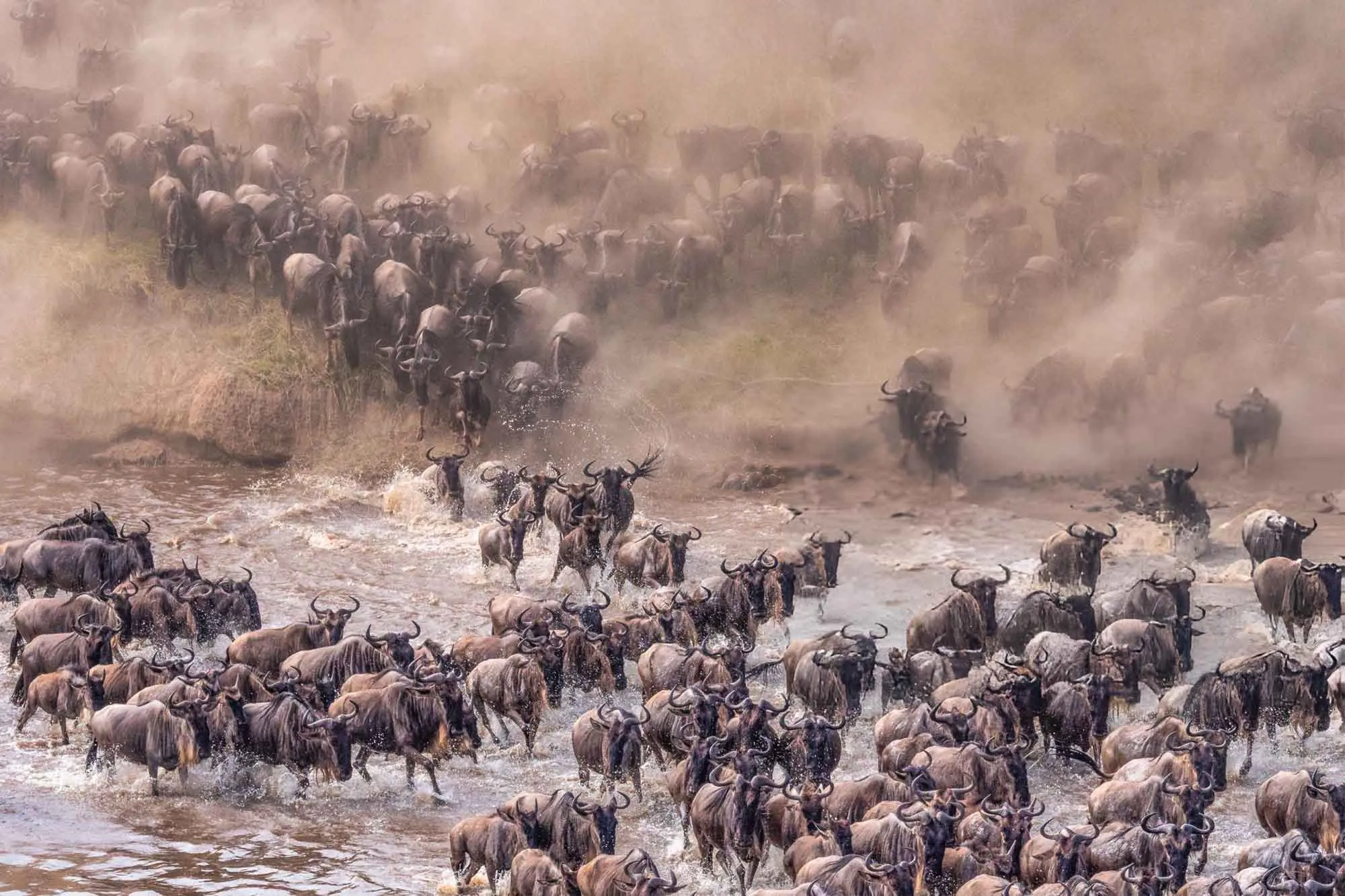
This is the period that the wildebeest, after having feasted on the short green grasses of the southeastern Serengeti and after having giving birth to their offspring, start getting ready for their 800 kilometer long trek. The actual starting date may be anytime between late April and early June. This is the time to you may have the privilege to see one of the greatest natural phenomena in the world: more than a million marching animals in a column up to 40 kilometers long. During the migration, the herd will move towards the Western Corridor, where they will face the first major obstacle: crossing the Grumeti River. Many animals don’t survive the crossing as they are being awaited by the area’s population of oversized crocodiles ready to feast. The herd may congregate on the southern bank of the river and stay there for up to two weeks before crossing the river.
August-September
When the Grumeti River obstacle has been taken, the herd moves further north and starts crossing the next big hurdle, the Mara River, in July or August. The Mara River crossing is where so many iconic Great Migration photos have been taken. After this crossing the herd flocks to the northwest plains and Masai Mara National Reserve in Kenya. The August – September period is considered being a bad time to visit Serengeti National Park and see the Great Migration as the herd moves into the Masai Mara in Kenya. However, migration patterns show that about half of the herd stays on the Tanzanian side, in the Mara Serengeti area. In this period, smaller herds of wildebeest (well consider small… herds may count up to between 500 and thousands of individuals) frequently cross the Mara River, back and forth, for no apparent reason. This is an excellent time to stay at one of the Serengeti Mara camps.
October-November
Crossing the Mara River northbound means that, at one point, the herd needs to cross the river one more time before commencing the trek back in a southerly direction. This usually happens in October, but sometimes earlier. In this period the herd will cross the northern plains and Lobo area. This section of Serengeti National Park is little-visited, so if you are looking to see the migration in relative quietness, this would be the time. The wildebeest return to the short- grass plains and calving ground around Ndutu in late November. And from here, the Great Migration starts all over again.
Note
As mentioned earlier, the timings outlined on this page concern guidelines as exceptions occur frequently. In November 2013, the wildebeest already started trekking back to the southern Serengeti short-grass plains when suddenly it started raining north of the Mara River. Nature is as nature does and the herd turned around, back into the Masai Mara in Kenya. The herd stayed there for about three weeks before resuming their southbound journey. A year later, in 2014, freak rains in the southern Serengeti caused much of the herd to remain behind and not make the northbound journey towards the Western Corridor up to July.

When to visit?
It is a matter of choice whether you would like to plan your Serengeti safari around the Great Migration. We have mentioned earlier that the Serengeti is a year-round destination as it covers a vast area and offers unparalleled wildlife viewing. Chances that you will be at the exact spot of the Great Migration herd crossing a river (either at the Grumeti or Mara River) are very slim. Also, the timing of herd movements cannot be guaranteed. However, if you choose the right part of the Serengeti: the southeast and Ndutu from December through to May, the Western Corridor from May to July, the Serengeti Mara area from July trough to October, and the northern Serengeti and Lobo area in October and November, large herds of wildebeest and their entourage should be easily located.
-
Tips for Planning Your Great Migration Safari
- Book early: Lodges and camps fill up quickly during peak migration months.
- Consider a flying safari: Save time and enjoy stunning aerial views of the Serengeti plains.
- Bring good photography gear: The migration offers some of the world’s most iconic wildlife scenes.
- Travel with experts: Choose experienced guides who understand the migration routes and behaviors.

Send your enquiry for a Serengeti safari
- Requesting a quote is free and there is no obligation to book